
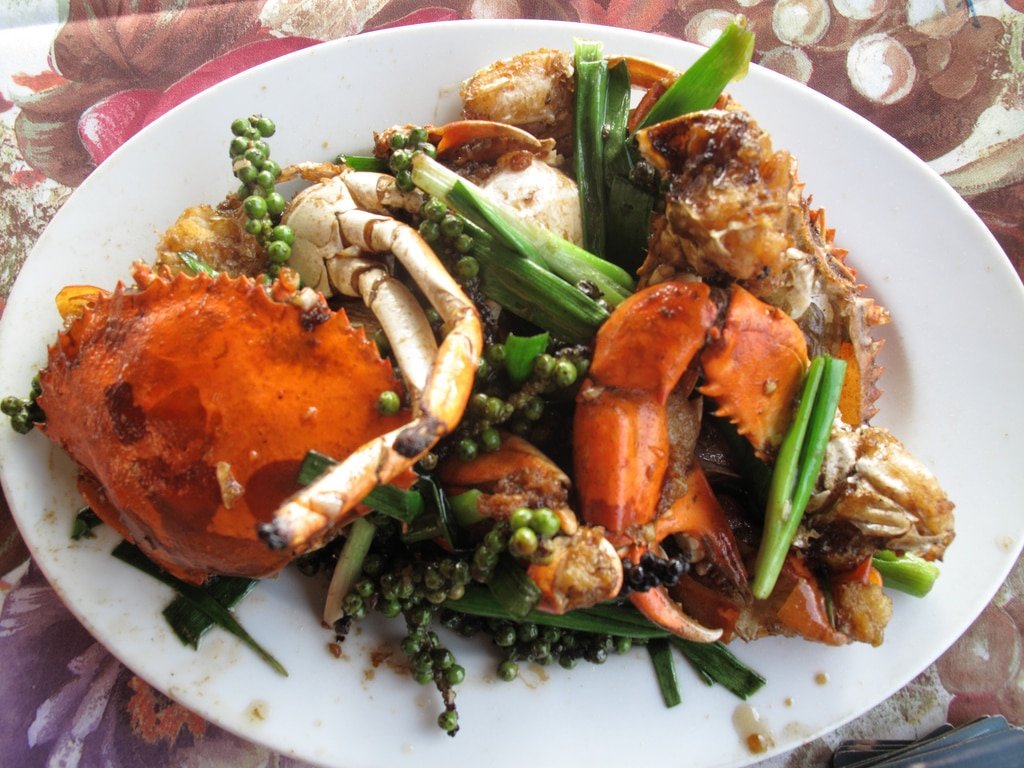
Where the Gulf of Thailand kisses the Cambodian coastline, a culinary treasure emerges from the depths of the sea. The blue swimmer crab—known locally as Kdam—has transformed Kep and Kampot into destinations for seafood lovers worldwide. This isn't just another ingredient; it's a living embodiment of Cambodia's coastal heritage, bringing stories of fishermen, tradition, and unparalleled flavor directly to your plate.
The Blue Gem: Understanding Kampot's Most Prized Crustacean
The Blue Swimmer's Distinctive Beauty
The blue swimmer crab, scientifically known as Portunus pelagicus, is nature's perfectly designed aquatic hunter. Males display a striking bright blue coloration with white spots, while females wear more subtle green and brown tones, their shells rounder and more delicate. These remarkable crustaceans can reach up to 20 centimeters across their carapace, their flattened paddle-like legs making them exceptional swimmers. Unlike many crab species, they carry distinctive long claws that would make any creature of the sea take notice.
What makes these crabs truly remarkable is their resilience and adaptability. They spend much of their time buried beneath sand and mud, emerging during high tide to feast on bivalves, fish, and marine organisms. This behavioral pattern, combined with their natural tolerance to various water conditions, makes them ideally suited to the brackish environments where Cambodia's rivers meet the sea. The carapace can withstand depths reaching 65 meters, though they thrive most abundantly in coastal waters where sunlight penetrates and food is plentiful.
Why Kampot Water Creates Superior Crabs
The waters surrounding Kampot Province have created perfect conditions for blue swimmer crabs to flourish. The region's geography—where freshwater flows from inland rivers meets the nutrient-rich Gulf of Thailand—creates an ideal habitat. These mineral-rich waters produce sweeter, more flavorful meat compared to crabs found elsewhere. Local fishermen know their waters intimately, understanding the tidal patterns and seasonal movements that make Kampot's crabs so sought-after.
The Kep Crab Market: Where Tradition Meets Commerce
A Living, Breathing Market
Step into the Kep Crab Market and you've entered a place where centuries-old fishing traditions continue uninterrupted. Located just 27 kilometers from Kampot town—a scenic 30 to 40-minute drive—the market comes alive at 5 AM every single day. This isn't theatre for tourists; it's the beating heart of a fishing community that has depended on these crustaceans for generations.
The market operates until 5:30 PM, though the real energy peaks during early morning hours when overnight fishing boats return with their live catch. Wooden baskets line the water's edge, submerged in the sea to keep crabs alive and fresh. Unlike markets where seafood sits on ice, here you can literally reach into an ocean basket and select your crab while it's still moving. This isn't convenience—it's authenticity. The crabs feel heavy in your hand, their shells solid evidence of nutrient-rich feeding grounds offshore.
Negotiating Your Perfect Crab
Walking through the market, tourists often feel intimidated by the apparent chaos—vendors enthusiastically shouting prices, the constant chatter in Khmer, locals moving with practiced efficiency. But here's where the magic happens. Haggling isn't just expected; it's part of the cultural exchange. While vendors might initially quote $4-5 per half kilogram, experienced negotiators regularly secure prices around $8 per kilogram for premium specimens. Your first quote is never your final price.
Local wisdom suggests selecting female crabs with roe—the creamy orange eggs visible inside the shell—as these deliver richer, more nuanced flavor. Feel the weight; heavier crabs indicate fuller bodies and more meat. Ask vendors about their catch; many take pride in explaining where their boats ventured overnight and what the conditions were like.
From Market to Plate in Minutes
What sets Kep apart from seafood markets globally is the immediate cooking service. Around thirty small family-run restaurants surround the market itself, built on platforms directly over the water. You purchase your crab at the market—often spending just $3-4 for a beautiful specimen—then carry it mere steps to a restaurant. The cooking charge? Roughly one dollar per kilogram, and within twenty minutes you're seated with your freshly prepared seafood, the sunset painting the sky in brilliant oranges and purples.
The restaurants serve simple, unfussy preparations that let the crab speak for itself. Grilled crabs arrive with minimal seasoning beyond salt and pepper. Stir-fried versions come with garlic and spring onions. But the signature preparation—Kdam Chha Mrech Kampot, or Kampot pepper crab—is where tradition and terroir converge into something unforgettable.
The Perfect Marriage: Kampot Pepper Meets Blue Crab
Understanding Kampot's World-Famous Pepper
Before exploring this iconic dish, you need to understand Kampot pepper itself. Growing in mineral-rich red soil just kilometers away from Kep, Kampot pepper has been cultivated for centuries using traditional methods unchanged by time. The vines are planted on sloped terrain with careful drainage, supported by wooden stakes, and shaded during their first three years. Farmers employ entirely natural fertilizers, avoiding chemicals that could diminish the pepper's complex character.
Harvesting occurs between February and April when peppercorns reach optimal ripeness. Unlike industrial pepper operations elsewhere, Kampot peppercorns are handpicked, then naturally dried under the sun for three days. This gentle drying process preserves the pepper's volatile oils, creating flavor complexity you simply cannot find in mass-produced alternatives. Experts describe Kampot pepper's profile as possessing subtle citrus notes, warm spiciness, and an aromatic depth that lingers on the palate.
The Alchemy of Chhar Kdam Merec
Kdam Chha Mrech Kampot—which translates simply as "crab with Kampot pepper"—ranks among Cambodia's most celebrated dishes. The preparation honors both ingredients without overpowering either. Fresh crabs are cut into manageable pieces and quickly stir-fried in oil infused with minced garlic and crushed fresh green Kampot peppercorns. This initial cooking allows the pepper's aromatics to bloom and meld with the crab's sweetness.
The sauce arrives next: a careful balance of fish sauce (providing umami depth), oyster sauce (adding complexity and body), palm sugar (rounding out rough edges), and a touch of garlic. Some preparations include spring onions and coriander, green peppercorns scattered throughout, and occasionally a squeeze of lime or tamarind juice adding bright acidity. The entire cooking process rarely exceeds ten minutes—high heat is essential to maintain the crab's tenderness while allowing the pepper's flavors to permeate every piece.
What makes this dish extraordinary isn't any single component but rather how each element elevates the others. The pepper brings its peppery warmth without heat that burns; the crab contributes natural sweetness and tender texture; the aromatic base of garlic and fish sauce creates a savory foundation; palm sugar bridges the gap between savory and sweet. Every bite delivers a complete flavor journey—peppery warmth, briny sweetness, aromatic complexity, and textural satisfaction.
The Fishing Community: Livelihoods Woven from the Sea
Generations of Knowledge
The fishermen who supply Kep's market come from families with generations of crabbing expertise. In communities like Trapeang Ropov and Angkaol Village, crab fishing represents more than a commercial enterprise—it's cultural identity passed from fathers to sons, mothers to daughters. These aren't factory workers; they're marine stewards who read water conditions, understand crab behavior, and know their fishing grounds with encyclopedic detail.
Traditional methods remain dominant. Fishermen still employ collapsible crab traps—ingenious devices that allow crabs to enter through a funnel but make escape nearly impossible. These traps are deployed from small wooden boats, often worked by entire family units. A successful fishing trip might yield 15-16 kilograms of quality crabs, representing roughly 8-10 hours of work and a catch worth approximately $25-30 USD after accounting for fuel and equipment costs.
Economic Lifeline
In villages surrounding Kep and Kampot, blue crabs provide the primary household income for hundreds of families. A successful fisherman might earn $25-30 daily—a respectable sum in rural Cambodia where living expenses remain modest. Yet income fluctuates seasonally. Catches peak between March and April when water conditions favor crab populations, yielding 15-17 kilograms per boat daily. By June, yields drop to around 8 kilograms daily as water temperatures rise and crabs venture into deeper waters.
Beyond fishing families, the crab economy supports middlemen, market vendors, restaurant owners, boat builders, and equipment suppliers. The market's thirty restaurants employ servers, cooks, and cleaners. Tour operators design day trips specifically around crab market experiences. What began as simple subsistence fishing has evolved into a tourism attraction generating economic activity far beyond the catch itself.
Culinary Traditions Beyond the Iconic Pepper Preparation
Exploring the Broader Crab Repertoire
While Kampot pepper crab receives justified accolades, Cambodian cooks prepare crabs in dozens of equally compelling ways. Amok Kdam (crab amok) presents fresh crab cooked in a delicate coconut milk sauce enriched with Khmer spice paste, then steamed inside banana leaves. This preparation highlights the crab's natural sweetness while the spice paste's aromatic components—turmeric, galangal, lemongrass, and shallots—create complexity without overwhelming.
Kdam Sach Kroeung (crab stir-fried with kroeung) combines freshly caught crabs with a carefully pounded paste of galangal, kaffir lime leaves, lemongrass, turmeric, shallots, and garlic. This ancient preparation method predates modern cooking and showcases how Cambodian culinary tradition emphasizes aromatic depth. The finished dish arrives steaming, each piece of crab coated in fragrant herbs and spices, every bite delivering unexpected bursts of fresh herb flavors alongside sweet crab meat.
Some coastal communities prepare Kdam Chhlong (grilled crab) using the most minimalist approach—crabs brushed with fish sauce and lime juice, then grilled directly over charcoal until the shells char and the meat becomes tender. This preparation requires superior crab quality, as nothing masks inferior specimens. In Kep, exceptional crabs prepared this way represent the purest expression of the ingredient itself.
The Umami Experience
Beyond recipes lies a deeper culinary principle. Crabs possess naturally high concentrations of umami compounds—the savory "fifth taste" that creates satisfaction and depth. The proteins in crab meat break down during cooking, releasing amino acids like glutamate that trigger umami receptors on your tongue. This explains why even simply prepared crabs feel so satisfying. Combined with fish sauce (umami-rich through fermentation), oyster sauce, and aromatics like garlic, Kampot crab dishes create an almost addictive quality. You finish eating and find yourself craving another bite almost immediately.
Planning Your Crab Adventure: Practical Essentials
Timing Your Visit for Maximum Flavor
Visit the Kep Crab Market as early as possible—ideally 7-9 AM when the freshest overnight catches are still abundant. By midday, selections diminish as the best specimens sell quickly. The market maintains consistent quality year-round since crabs are caught daily, but March through May sees the highest catches and most diverse size options.
What to Bring and Know
Bring cash—most vendors accept only local currency (Cambodian riel) or USD. Small denominations facilitate haggling. Wear comfortable walking shoes as you'll wander uneven market terrain. The market, though bustling, remains organized; vendors in one section deal exclusively in crabs, others in squid or shrimp.
Most importantly, embrace the experience's simplicity. This isn't a sanitized tourist attraction but a genuine working market where actual commerce unfolds. Fishermen unload catch, locals purchase their dinner, and visitors gain authentic glimpses into coastal Cambodian life. Your respectful presence and genuine interest in the process earn smiles and often better prices.
Beyond the Market: The Broader Kampot-Kep Experience
While crabs headline the visit, the region offers complementary experiences. Many resorts arrange day trips incorporating the Kep Crab Market with Kampot pepper farm tours. La Plantation, a restored plantation dating to the French colonial period, offers guided walks through pepper fields, detailed explanations of cultivation and processing, and tastings of various Kampot pepper varieties. This context enriches your understanding of how the region's two most celebrated products—pepper and crab—create the perfect culinary pairing.
Kep Beach provides relaxation between market visits. Bokor Hill Station, an abandoned French colonial hill station now partially restored, offers historical perspective and dramatic coastal views. The Secret Lake provides swimming and picnicking opportunities amidst peaceful countryside. Yet for most visitors, the experience centers appropriately on the market, the meal, and the connection between sea, tradition, and sustenance.
Health Benefits: More Than Just Delicious
The Nutritional Profile
Crab delivers impressive nutritional density alongside pleasure. A hundred-gram serving contains approximately 20 grams of protein—essential for muscle maintenance and repair—combined with minimal saturated fat. This makes crab an excellent choice for health-conscious diners seeking protein without excess calories or dietary compromise.
Beyond protein, crabs provide selenium in concentrations 12 times higher than typical red meat. This essential mineral supports immune function and thyroid health. Crabs also deliver significant quantities of zinc, crucial for immune response and wound healing. The omega-3 fatty acids found throughout crab meat have demonstrated cardiovascular benefits, helping lower cholesterol and reduce stroke and heart attack risk.
The phosphorus content supports bone health and strength. Copper, another abundant mineral, improves iron absorption and red blood cell production, enhancing circulation and recovery from injury or illness. B vitamins including B12 support energy production and cognitive function. Simply stated, eating crab isn't indulgence at the expense of health—it's conscious nutrition wrapped in culinary pleasure.
Sustainability Considerations: The Future of Cambodian Crabs
Understanding Current Challenges
While Kampot and Kep crabs remain abundant, fishing communities face real pressures. Climate change affects water temperatures and seasonal patterns. Coastal development encroaches on mangrove habitats crucial for juvenile crabs. Competition from commercial-scale operations sometimes tensions with small-scale community fishermen.
Yet reason for optimism exists. Community Fisheries organizations have implemented sustainable management practices including seasonal closures and zoning that reserves specific areas for small-scale gear. Academic research studies crab populations, providing data for informed management decisions. By choosing to eat crabs caught through traditional methods by community fishermen rather than industrial operations, visitors actively support sustainability practices and local livelihoods.
Start Your Crab Journey
The culinary story of Kampot crab extends far beyond a single meal or market visit. It encompasses generations of fishing tradition, a region's agricultural bounty, and the remarkable alchemy that occurs when extraordinary ingredients meet skilled preparation. Whether you're savoring Kdam Chha Mrech Kampot at a restaurant overlooking the gulf, selecting live crabs directly from ocean baskets at dawn, or learning about sustainable fishing practices from local guides, you're participating in something profound—the continuation of a coastal culture that has thrived for centuries.
Plan your visit to Kep and Kampot. Rise early to experience the market's energy and authenticity. Negotiate for your perfect crab. Watch skilled cooks transform your selection into edible poetry. Dine as the sun sets, the sea breeze carrying salt and warmth, each bite connecting you to fishermen, their families, the traditions they've honored, and the waters that provide so generously.
This isn't just food tourism—it's cultural immersion. This isn't merely dining—it's participation in the continuation of something irreplaceable. Kampot's blue crabs await, ready to tell their story, one delicious bite at a time.
