
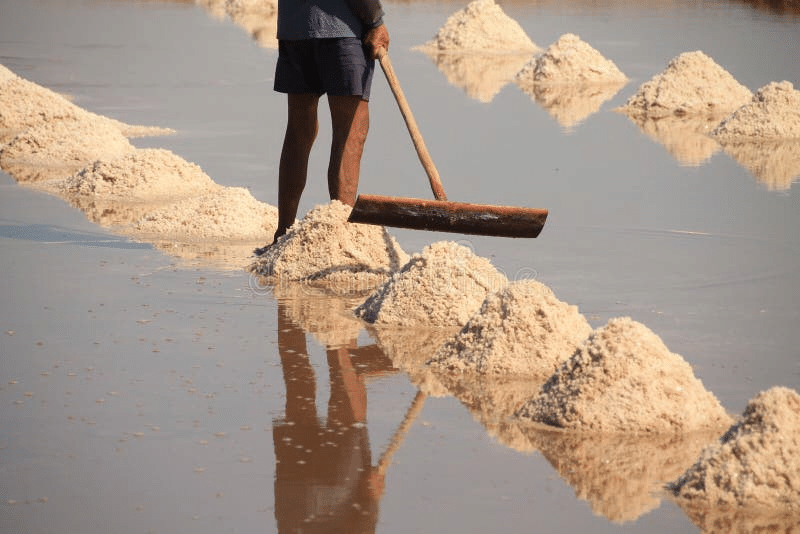
Beneath Cambodia's brilliant tropical sun, where the Gulf of Thailand meets the fertile coastal plains of Kampot Province, an extraordinary landscape unfolds. Vast expanses of shallow pools shimmer like mirrors, reflecting the sky while producing one of Southeast Asia's most treasured culinary ingredients. These salt fields represent far more than scenic beauty—they embody centuries of traditional craftsmanship, where farmers continue practicing ancient techniques passed down through generations, transforming seawater into crystalline treasure through patience, skill, and the raw power of nature.
Kampot salt fields at sunset showcasing traditional sea salt harvesting ponds and rustic storage huts
Where Earth Meets Sea: Understanding Kampot's Salt-Making Geography
The coastal provinces of Kampot and Kep harbor approximately 4,721 hectares of salt fields, with Kampot Province accounting for 3,726 hectares and Kep Province contributing 995 hectares. This extensive landscape represents Cambodia's primary salt-producing region, where approximately 200 families have dedicated their livelihoods to this demanding yet rewarding craft.
Located just kilometers from Kampot town, these fields occupy the flat coastal plains stretching between the Elephant Mountains and the sea. The geographical positioning creates ideal conditions for solar salt production—a flat terrain that allows for extensive shallow ponds, proximity to clean seawater from the Gulf of Thailand, and exposure to intense tropical sunlight throughout the dry season.
The region's natural advantages extend beyond mere geography. The clay-rich soil beneath the salt pans can be compacted and prepared to create watertight basins where seawater evaporates efficiently. This unique terroir, combined with specific climatic conditions during the dry season from December to April, creates the perfect environment for producing salt with distinctive mineral characteristics.
The Solar Evaporation Method: An Ancient Craft Preserved
Solar evaporation remains the oldest known method of salt production, dating back millennia when ancient civilizations first noticed salt crystals forming in trapped pools of seawater. In Kampot, this time-honored technique continues largely unchanged, relying entirely on natural forces rather than industrial machinery.
Preparing the Salt Pans
The salt-making season begins with meticulous preparation during October and November, just as Cambodia's rainy season draws to a close. Farmers must prepare channels and dikes, ensuring water flows properly through their systems. The clay surface of evaporation pools requires compacting using simple pounding implements, creating a firm, impermeable base that prevents seawater from seeping into the ground.
This preparation demands considerable physical labor and expertise. Workers use wooden tools—hoes, spades, rakes, and baskets—crafted from local materials using techniques refined over generations. These implements remain the primary equipment for Kampot's salt farmers, who eschew mechanization in favor of traditional methods that ensure product purity and maintain cultural heritage.
Harvesting Seawater
Once the pans are prepared, production begins in earnest. Farmers rise before dawn, often starting work before sunrise to maximize productive hours during the coolest part of the day. Using diesel-powered pumps—one concession to modernity—seawater is collected either directly from the sea or from interconnected canals, then introduced into reservoir ponds.
From these reservoir ponds, water flows through a carefully designed series of evaporation pools, typically five in succession. As water moves from one pool to the next over approximately 40 days, salinity increases progressively. This gradual concentration process is crucial, as it allows impurities to separate and be drained away, ensuring the final product's purity.
The Evaporation Process
The evaporation pools represent the heart of salt production. These shallow basins, filled with just enough water to create expansive surface area, harness the tropical sun's intense heat and wind to drive moisture into the atmosphere. The salinity increases from typical seawater concentration of 25 milligrams per liter to over 300 milligrams per liter—a concentration so high that no bacteria can survive.
This process requires anywhere from two to five days depending on weather conditions, with temperature, humidity, and wind all playing critical roles. During this time, farmers monitor their ponds closely, observing water levels and salt formation, making adjustments as needed to optimize crystallization.
Harvesting the White Gold
When evaporation reaches the crystallization pond—the final basin in the series—salt begins precipitating out of the saturated brine. Salt crystals accumulate on the water's surface and gradually sink to the pond floor, creating a thick crust of pure white crystals.
At this critical moment, farmers wade into the shallow ponds with their wooden rakes, carefully scraping and gathering the crystallized salt. They rake it into small conical piles where it continues drying under the relentless sun. This manual harvesting occurs primarily from January through March, when conditions are most favorable.
Workers then transfer the dried salt into bamboo baskets, carrying them on poles spanning their shoulders—a traditional transport method that speaks to the physical demands of this work. The salt is stored in warehouses at the field edges, awaiting final processing, iodization (required by Cambodian law), and packaging.
The Precious Fleur de Sel: Kampot's Culinary Crown Jewel
Among the various salts produced in Kampot's fields, one variety stands above all others in prestige and price: Kampot Flower of Salt, known internationally by its French name, fleur de sel.
This delicate product forms only under precise conditions during the hottest months—April and May—when temperatures peak and winds remain minimal. The fleur de sel develops as a fragile, gossamer-thin crust of fine crystals on the water's surface, lasting just briefly before sinking.
Harvesting this ephemeral treasure requires exceptional skill and timing. Farmers must use special dedicated tools to skim the delicate crystals from the surface before they descend to the pond floor. The window of opportunity is narrow, and any delay results in lost harvest as the crystals sink and mix with regular salt.
A bowl of Kampot fleur de sel sea salt crystals on a wooden surface with herbs in the background
The effort produces remarkably small quantities. For every 30 kilograms of regular sea salt harvested, farmers collect just one kilogram of fleur de sel. This scarcity, combined with the labor-intensive harvesting method and the salt's superior culinary qualities, makes Kampot's fleur de sel a premium product sought by gourmet chefs worldwide.
French salt-makers from Guérande in Brittany—renowned for their own fleur de sel production spanning centuries—arrived in Kampot in 2012 to share their exacting techniques. This knowledge transfer helped Kampot farmers refine their methods while maintaining traditional approaches, resulting in a product that rivals the world's finest specialty salts.
Geographic Indication: Protecting Kampot's Salt Heritage
In April 2023, Kampot-Kep salt achieved a milestone that recognized its unique qualities and traditional production methods: registration as a Geographical Indication (GI) product. This certification, similar to the protections afforded to Champagne in France or Parma Ham in Italy, acknowledges that the salt's distinctive characteristics are specifically attributable to its geographical origin within Kampot and Kep provinces.
The GI status establishes strict production standards that registered farmers must follow. These requirements ensure that only salt produced using traditional methods in designated areas can bear the Kampot-Kep Salt name, protecting both consumers and artisan producers from imitation products.
For Kampot's salt farming families, GI certification represents hope for economic sustainability. The designation allows them to command premium prices—typically 30 to 50 percent higher than regular salt—that reflect the product's superior quality and artisanal production methods. Currently, eleven families produce certified GI Kampot-Kep Salt, collectively managing approximately 133.5 hectares during the production season.
This recognition also opens international markets. Previously, Kampot salt exports remained limited, often piggy-backing alongside the region's famous Kampot pepper shipments. Following GI registration, exports began expanding to Japan, European nations including France, Switzerland, and the Czech Republic, and potential new markets in South Korea and China.
The Salt Farmer's Life: Labor Under the Tropical Sun
Salt production in Kampot demands extraordinary physical endurance and dedication. The work occurs during Cambodia's hottest months, when temperatures regularly exceed 35°C and the sun beats down relentlessly on exposed fields.
Farmers begin their days in pre-dawn darkness, arriving at the fields before sunrise to work during relatively cooler morning hours. They return after a midday break when heat becomes most oppressive, continuing until sunset. This grueling schedule continues for four to six months annually, from December through April, comprising the entirety of Cambodia's dry season.
The physical labor is intense. Workers wade through shallow brine wearing minimal protective clothing, their skin exposed to caustic saltwater and burning sun. They must be completely covered to protect against UV radiation, even as temperatures soar. Each basket of wet salt weighs approximately 25 kilograms, and farmers carry dozens of these loads daily using traditional shoulder poles.
A Kampot salt field worker manually harvesting sea salt using a wooden tool, illustrating the traditional salt farming technique
Despite these harsh conditions, many families view salt farming as their heritage and pride. Knowledge passes from parents to children, with younger generations learning the subtle skills required to optimize production—understanding how weather affects crystallization, recognizing when salt is ready for harvest, and maintaining the delicate balance of the evaporation system.
Economic realities remain challenging. Salt workers earn approximately $6 to $8 per day during production season. For families who own their own fields, profits can be more substantial, but many work as laborers on others' land, receiving modest wages for backbreaking work.
The industry provides livelihoods for approximately 1,474 people across Kampot and Kep provinces. During the off-season, many salt farming families switch to rice cultivation, fishing, or other agricultural work, maintaining diversified income sources that help them weather Cambodia's unpredictable climate.
Challenges Threatening an Ancient Tradition
While Kampot's salt fields have endured for generations, multiple pressures now threaten this traditional industry's future sustainability.
Climate Change and Unpredictable Weather
Salt production depends entirely on predictable weather patterns—specifically, a dry season with minimal rainfall, intense sunshine, and steady winds. Climate change disrupts these patterns, introducing unprecedented uncertainty.
Increased rainfall during what should be the dry season has devastated production in recent years. In 2017, the region experienced unseasonably heavy rains throughout the harvest period, reducing yields from 174,000 tonnes in 2015 to just 27,000 tonnes. The 2018 season proved even worse, with almost no salt harvested because unexpected precipitation repeatedly flooded the evaporation ponds, dissolving accumulated salt crystals and restarting the process.
Even small amounts of rain at critical moments can ruin weeks of work. When saltwater has concentrated after days of evaporation and crystals have begun forming, a sudden storm can wash everything away, forcing farmers to pump in fresh seawater and begin again.
Rising sea levels pose additional threats. Storm surges and coastal flooding can overwhelm protective dikes, inundating fields with excessive water that takes longer to evaporate. Higher baseline sea levels also affect the hydrology of coastal areas, potentially altering the delicate water management systems that salt farming requires.
Market Competition
Kampot's traditional salt faces fierce competition from cheaper imported salt, particularly from neighboring countries like Thailand and China. These imported products often cost significantly less—sometimes just $90 per tonne including shipping—making them attractive to price-conscious consumers.
Many Cambodian consumers cannot discern quality differences between artisan sea salt and industrially refined imports, focusing primarily on price. This creates a paradoxical situation where Cambodia exports premium Kampot salt to European markets willing to pay premium prices, while importing cheaper salt for domestic consumption.
The whiteness of salt also influences consumer preferences. Industrial refining produces brilliantly white salt through chemical processing, while Kampot's natural salt may have subtle off-white or grayish tones depending on mineral content. Some consumers mistakenly interpret this natural coloration as inferior quality, further disadvantaging traditional producers.
Labor Shortages
Younger generations increasingly shun the arduous physical labor that salt farming demands. Urban migration draws young people away from rural agricultural work toward opportunities in cities or the growing tourism and manufacturing sectors.
This labor exodus leaves aging farmers struggling to maintain production levels. Some fields lie fallow simply because insufficient workers remain to manage them. The knowledge required for successful salt farming—developed through years of experience—risks being lost as fewer young people apprentice in the craft.
Experiencing Kampot's Salt Fields: A Tourist Destination
While salt fields serve primarily as working agricultural landscapes, they have increasingly attracted visitors seeking authentic cultural experiences.
The fields themselves create stunning visual compositions. During production season, geometric patterns of rectangular ponds stretch across the plains, creating mirror-like surfaces that reflect the sky. Pyramidal mounds of harvested salt dot the landscape like miniature mountains, their brilliant white contrasting against the brown earth and blue sky.
Photography enthusiasts find endless inspiration in these scenes, particularly during early morning and late afternoon when golden light illuminates the fields. Sunsets over the salt pans have become iconic images of Kampot, with the sky's colors reflecting in the shallow waters to create ethereal, dreamlike landscapes.
Visiting during harvest season offers opportunities to observe salt farmers at work. Watching them rake salt into piles with methodical precision, carry heavy baskets on shoulder poles, or skim delicate fleur de sel from pond surfaces provides insight into this demanding traditional craft.
Many tour operators now include salt field visits in countryside excursions that also feature pepper plantations, caves, and the Secret Lake. These half-day or full-day tours typically depart from Kampot town, traveling by tuk-tuk or minibus to the fields located 15-20 minutes away.
However, timing matters critically. The optimal visiting period runs from December through April—the dry season when production occurs in full swing. During Cambodia's rainy season from May through October, salt production ceases entirely, and fields may be flooded or empty, offering little to observe.
Responsible tourism practices remain important. Visitors should recognize that these are working agricultural lands where families earn their livelihoods through demanding physical labor. Respectful observation, supporting local producers by purchasing their products, and understanding the challenges they face helps ensure that tourism benefits rather than burdens salt farming communities.
The Mineral Treasure Within: Health and Culinary Value
Kampot's artisanal sea salt offers qualities that distinguish it from industrially processed table salt. The traditional solar evaporation method preserves natural minerals present in seawater, creating a product rich in trace elements including calcium, magnesium, potassium, iron, and zinc.
These minerals contribute to both flavor complexity and potential health benefits. Calcium and magnesium support proper muscle contraction and nervous system function. Magnesium specifically helps regulate blood pressure when salt is consumed in moderation. The presence of various trace minerals creates subtle flavor nuances that chefs and food enthusiasts appreciate, adding depth beyond simple saltiness.
Kampot's fleur de sel contains particularly high concentrations of calcium and magnesium compared to regular salt. Its delicate, flaky texture and mild flavor with subtle sweetness make it ideal as a finishing salt, sprinkled on dishes just before serving to provide both seasoning and textural interest.
The salt remains unrefined and free from additives except for iodine, which Cambodian law mandates to address national iodine deficiency concerns. This minimal processing preserves the salt's natural character while ensuring it contributes to public health objectives.
Food safety researchers have confirmed that proper salt production methods, including the high concentrations achieved during evaporation, create an environment where bacteria cannot survive. The natural purity of Kampot's salt, combined with traditional storage methods that keep it free from foreign matter, results in a product that meets international food safety standards.
Preserving Heritage for Future Generations
As Cambodia develops economically and younger generations pursue modern careers, questions arise about traditional crafts' futures. Salt farming, like many heritage industries, stands at a crossroads between preservation and adaptation.
The Geographical Indication certification represents one strategy for protecting this cultural heritage while ensuring economic viability. By establishing quality standards, providing legal protections against imitation, and facilitating access to premium markets, GI status helps traditional producers compete in the global economy.
Organizations supporting craft preservation recognize that sustainability requires more than romantic appeals to tradition. Economic incentives matter. If salt farming can provide adequate livelihoods, younger generations may choose to continue the practice. If it cannot compete financially with other opportunities, the knowledge will fade regardless of cultural value.
Some producers are exploring innovations that preserve core traditional methods while improving efficiency or adding value. These include better quality control systems, enhanced packaging that communicates the product's story and premium nature, direct marketing to consumers and restaurants, and agri-tourism that generates supplementary income.
The challenge lies in balancing innovation with authenticity. Consumers seeking artisan products value genuine traditional methods. Industrial-scale production or mechanization, while potentially more profitable, would undermine the very qualities that make Kampot salt special.
Educational initiatives also play crucial roles. As younger Cambodians learn about their cultural heritage and understand the value of traditional crafts, some may develop renewed appreciation and interest in continuing these practices. International recognition through GI certification and export success demonstrates that traditional knowledge holds commercial value in contemporary markets.
The Cycle Continues: Salt as Living Heritage
Walking through Kampot's salt fields during harvest season, observing farmers methodically raking crystalline mounds under the scorching sun, one witnesses not merely agricultural production but living cultural heritage. These landscapes embody centuries of accumulated knowledge about reading weather patterns, managing water flow, and coaxing salt from the sea using nothing but sun, wind, and patient labor.
The workers in these fields—many wearing traditional clothing, using tools crafted from local wood, speaking Khmer while they work—provide tangible connections to Cambodia's past. Their continued practice of traditional techniques represents resistance against homogenization, affirming that ancient wisdom retains relevance in the modern world.
Yet this heritage remains vulnerable. Climate change threatens to disrupt the predictable weather patterns upon which traditional salt farming depends. Market forces favor industrial efficiency over artisanal quality. Younger generations increasingly seek less physically demanding careers with higher economic returns.
Whether Kampot's salt fields will continue producing their distinctive product for future generations depends on multiple factors: climate stability, market demand for premium artisan products, economic policies supporting traditional industries, and whether enough people—both producers and consumers—value this heritage sufficiently to sustain it.
For visitors seeking authentic cultural experiences, for chefs pursuing the finest culinary ingredients, and for anyone who appreciates the beauty of traditional craftsmanship, Kampot's salt fields offer something increasingly rare: a glimpse into timeless human ingenuity, where simple materials and ancient techniques create products of extraordinary quality and meaning.
Discover Kampot's Treasures at Queen Island Kampot Resort
Cambodia's coastal region offers far more than salt fields alone. While exploring the traditional craftsmanship and stunning landscapes surrounding Kampot, travelers seeking exceptional hospitality will find the perfect retreat waiting for them.
Queen Island Kampot Resort provides an ideal base for discovering the region's hidden gems. Nestled in a tranquil riverside setting, the resort offers comfortable houseguest accommodations where visitors can relax after days spent touring salt fields, pepper plantations, and other cultural attractions. The peaceful island location creates a serene escape from everyday life while maintaining convenient access to Kampot's main sights.
Beyond comfortable lodging, the resort caters to adventure enthusiasts with exciting water activities. Jet ski excursions across the river provide thrilling experiences, while the riverside setting offers opportunities for peaceful contemplation of Cambodia's natural beauty. Whether you're drawn to exploring traditional crafts like salt harvesting or seeking adrenaline-pumping water sports, Queen Island Kampot Resort delivers the perfect balance.
Ready to experience Kampot's authentic heritage and natural wonders? Book your stay at Queen Island Kampot Resort today and immerse yourself in Cambodia's coastal magic. Discover where traditional craftsmanship meets modern comfort, where ancient salt fields stretch beneath tropical skies, and where your Cambodian adventure truly begins. Don't just visit Kampot—experience it from the tranquil sanctuary of Queen Island.
